

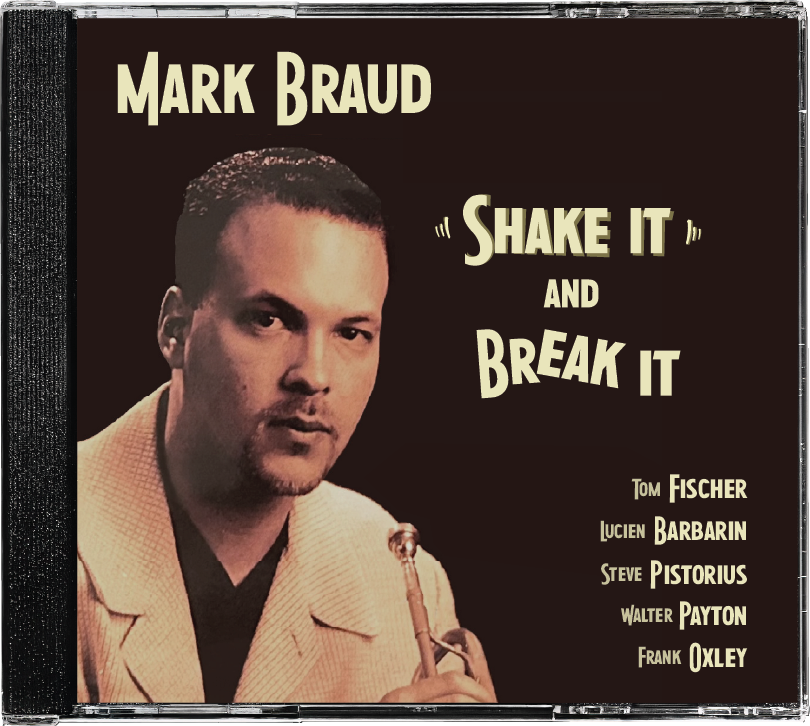


Mark Braud stands firmly in the living, authentic flow of New Orleans music—a continuing tradition not preserved, but carried forward, generation to generation, on bandstands, in parades, and deep in the culture and heritage of the city itself. When this recording was first released in 2002, Braud was just 29, yet he already spoke the language with depth, authority, and maturity—a nod to the elders who shared their craft with him.
His trumpet playing reflects both heritage and individuality. Descended from a distinguished family of trumpet players, including his grandfather John “Pickey” Brunious and uncles Wendell and John Brunious, Jr., Braud’s sound is grounded, assured, and expressive. His path as a bandleader and torchbearer of this music feels not only natural, but inevitable.
At his side is trombonist Lucien Barbarin, also from a storied musical lineage, whose playing embodies the earthy, tailgate tradition, full of funky looseness and wit that lifts the music and gives it humor. Clarinetist Tom Fischer completes the front line, weaving seamlessly through the collective improvisation with impeccable craft and phrasing—a true master.
The rhythm section lays a rock-solid foundation. Legendary bassist Walter Payton anchors the music with authority drawn from decades of experience, while pianist Steve Pistorius commands the traditional New Orleans stride style with grace and precision. Drummer Frank Oxley drives the band with a pulse steeped in the lineage of New Orleans drumming.
From the opening strains of “Fidgety Feet,” the band declares its intent: this is music played with understanding, not imitation. The song unfolds with ease, handled confidently at every turn. Braud’s trumpet breaks nod subtly to Louis Armstrong without ever losing his own voice.
“Way Down Yonder in New Orleans” reveals another side of Braud’s artistry. His vocal is warm, unforced, and remarkably mature, supported by Barbarin’s understated accompaniment.
On “Careless Love,” the tempo relaxes into a slow-drag groove. Muted brass adds color and blends seamlessly with the clarinet’s impeccable phrasing, while Oxley’s press rolls provide authentic grounding to this classic tune.
“Shake It and Break It” captures the energy and spirit at the heart of traditional New Orleans style. The band moves fluidly between two-beat and four-beat feels, demonstrating the collective intuition that defines New Orleans ensemble playing, each chorus building to a red-hot finale.
The New Orleans jazz standard “Bill Bailey” finds the band approaching this warhorse with both respect and exuberance. The authentic New Orleans groove on display kicks with a lively exchange of horn interplay. Braud’s vocals are distinctly his own, though there is a subtle influence from the great singer and bassist George French, with whom he has performed many times. Barbarin and Fischer demonstrate how trombone and clarinet can perfect a musical conversation, delivering two dirty, funky, growling choruses before giving way to an additional hot trumpet solo. The final two choruses build to a climactic ensemble improvisation, showcasing the skill of these three horn masters—a quality that resonates throughout the entire record.
Jelly Roll Morton composed “Winin’ Boy Blues” in 1915, and this version features the pared-down pairing of trumpet and piano. Braud and Pistorius play as if on a late-night gig in an old New Orleans dance hall, reminiscent of Louis Armstrong and Earl Hines, who famously recorded as a duo. Braud’s trumpet breaks are spot-on, and there is a distinct sense of rhythmic freedom between the two musicians.
“Floating Down The Old Green River” begins with a bass introduction, with Walter Payton stating the melody. Braud then enters vocally as Payton lays down a solid two-beat feel, later shifting into a swinging four-beat groove. The horn interaction is impeccable, and Pistorius’s piano solo is full of flavor. The out chorus lifts off with Oxley at the wheel, driving the band to a scorching finish.
The seldom-played “Four or Five Times” is relaxed and swinging from the first note. The horns on this track—trumpet and clarinet—playfully bounce off one another, while the rhythm section is anchored by Payton’s expert two-beat feel throughout. Oxley channels the traditional New Orleans drumming style on snare and rim, and Pistorius comps with precision and taste. The tempo and interplay make this a perfect dance number.
“The Sheik of Araby” features Braud on vocals for the first two choruses, followed by yet another superb piano solo from Pistorius. Braud’s trumpet solo highlights his skill and command, which are evident throughout the record. Trombone and clarinet return for another engaging musical conversation in classic New Orleans style, leading to a spirited, fitting conclusion.
“China Boy” closes this magnificent record at a hard swing. The horns and piano display remarkable dexterity and fire—it’s blazing. The entire album is red-hot!
This 2002 recording by Mark Braud is filled with true New Orleans all-star musicians who both contribute to and embody the culture. Each is a star and a leader in their own right, with extensive recording and playing experience; they speak the tradition. This music is timeless—one of those records that younger generations will hear and recognize as the real deal. It’s the kind of recording you can return to again and again. It is direct, alive and unmistakably real.
- Craig Klein, GRAMMY Award-winning trombonist, founding member of the New Orleans Nightcrawlers and Colossus Brass Band, and New Orleans’ WWOZ D.J. Sparky